Workplace Germ Control: How Professional Cleaning Fights Illness in Beverly Grove Offices
Every winter, and increasingly throughout the year, Beverly Grove offices face the same predictable pattern: one employee comes to work sick, and within days, half the office is coughing, sneezing, and taking sick days. The productivity loss, the disruption to operations, the overburden on healthy employees covering for absent colleagues—this cycle repeats annually, costing businesses thousands in lost productivity while reducing workplace morale and satisfaction.
Yet most Beverly Grove office managers assume this is inevitable—just part of doing business. It’s not. The difference between workplaces ravaged by seasonal illness and those maintaining healthy, productive teams often comes down to one critical factor: professional commercial cleaning that actively fights germ transmission rather than just making surfaces look clean.
Standard office cleaning focuses on visible dirt and aesthetics. Professional sanitization and disinfection services target invisible threats—the bacteria and viruses that spread illness through shared spaces. Cleaning West works with numerous Beverly Grove offices where strategic germ control through professional cleaning has measurably reduced sick days, improved productivity, and created healthier work environments. This guide explores exactly how germs spread in office environments and how professional cleaning interrupts transmission cycles that DIY approaches simply cannot address.
Quick Answer
Professional office cleaning fights illness in Beverly Grove workplaces through systematic disinfection of high-touch surfaces, proper sanitization protocols that kill germs rather than spread them, use of EPA-approved disinfectants with appropriate dwell times, and addressing areas like HVAC systems, bathrooms, and break rooms where germ concentration is highest. Businesses implementing professional sanitization protocols see 20-40% reductions in sick days, saving $500-$2,000+ per employee annually in lost productivity while improving workplace morale and reducing illness-related disruptions.
Understanding How Germs Spread in Office Environments
Before addressing solutions, understanding the problem helps Beverly Grove office managers appreciate why standard cleaning approaches fail to protect employee health.
Primary transmission routes:
Direct contact transmission: Employees touch contaminated surfaces (door handles, keyboards, phones, shared equipment), then touch their faces—eyes, nose, mouth—transferring pathogens to mucous membranes where infection begins.
Studies show people touch their faces 15-23 times per hour on average. Each touch is potential disease transmission from contaminated surfaces.
Fomite transmission: Inanimate objects (fomites) harbor germs that survive for hours to days depending on the pathogen and surface type. Common office fomites include:
- Door handles and push plates
- Light switches
- Elevator buttons
- Shared equipment (printers, copiers, coffee makers)
- Keyboards and mice
- Phones and tablets
- Refrigerator handles
- Faucets and soap dispensers
- Conference room surfaces and remotes
When one sick person touches these surfaces, they become germ reservoirs infecting subsequent people who touch them.
Airborne transmission: Coughing, sneezing, or even breathing releases respiratory droplets containing viruses and bacteria. These droplets:
- Settle on surfaces (becoming fomites)
- Remain airborne briefly, potentially infecting people nearby
- Accumulate in poorly ventilated spaces
Survival times of common pathogens:
Different germs survive varying lengths on surfaces:
Influenza virus: 24-48 hours on hard surfaces Common cold viruses: Up to 7 days on surfaces Norovirus (stomach flu): Days to weeks on surfaces Strep bacteria: Days on dry surfaces Staph bacteria: Weeks to months on surfaces COVID-19: Several hours to days depending on surface type
These survival times mean one sick employee can contaminate surfaces that infect colleagues days later—even after the original person recovers and returns to work.
High-risk office areas:
Bathrooms: Highest germ concentration due to biological waste, frequent hand contact, and moisture supporting germ survival. Faucets, soap dispensers, door handles, and flush handles are particularly contaminated.
Break rooms and kitchens: Shared refrigerators, microwaves, coffee makers, and eating surfaces combine food residue (germ food source) with frequent hand contact from multiple employees.
Conference rooms: Shared tables, chairs, remotes, and whiteboards used by multiple people throughout the day without cleaning between uses.
Reception and common areas: High-traffic zones with door handles, reception desk surfaces, and waiting area furniture contacted by employees, clients, and visitors.
Individual workstations: Personal spaces often neglected in standard cleaning but harboring significant germ loads from daily use.
Why standard cleaning fails:
Visual focus: Most cleaning focuses on visible dirt—trash removal, vacuuming, dusting. Germs are invisible, so visual cleanliness doesn’t equal microbial cleanliness.
Wrong products: General-purpose cleaners remove dirt but don’t necessarily kill germs. Disinfection requires specific products with antimicrobial properties.
Inadequate contact time: Even when disinfectants are used, they require “dwell time”—remaining wet on surfaces for specified minutes to kill germs. Quick spray-and-wipe (common in rushed cleaning) doesn’t allow sufficient kill time.
Incomplete coverage: Standard cleaning may miss high-touch points like light switches, door handles, or phone handsets while focusing on floors and larger surfaces.
Cross-contamination: Using the same cloth or mop across multiple areas without proper sanitization between uses spreads germs rather than eliminating them.
The Professional Approach to Germ Control
Professional commercial cleaning services approach sanitization systematically, addressing transmission routes that standard cleaning overlooks.
EPA-registered disinfectants:
Professional services use EPA-approved disinfectants proven effective against specific pathogens:
Hospital-grade disinfectants: Kill 99.9% of germs including bacteria, viruses, and fungi when used correctly.
Appropriate product selection: Different situations require different disinfectants—high-touch surfaces vs. floors vs. electronics. Professionals understand which products work where.
Proper concentration: Disinfectants must be diluted correctly—too weak and they don’t kill germs, too strong and they can damage surfaces or create health hazards.
Label compliance: Professional cleaners follow EPA label requirements including:
- Proper application methods
- Required contact (dwell) time before wiping
- Personal protective equipment
- Surface compatibility
Systematic high-touch surface attention:
Professional services prioritize areas where germs concentrate and transmit:
Daily high-touch disinfection:
- Door handles, push plates, and pulls
- Light switches throughout office
- Elevator buttons and handrails
- Bathroom fixtures (faucets, flush handles, dispensers)
- Kitchen/break room surfaces and appliances
- Reception desk and common area furniture
- Conference room tables, chairs, and equipment
- Stair railings
- Shared equipment (printers, copiers, scanners)
Workstation attention:
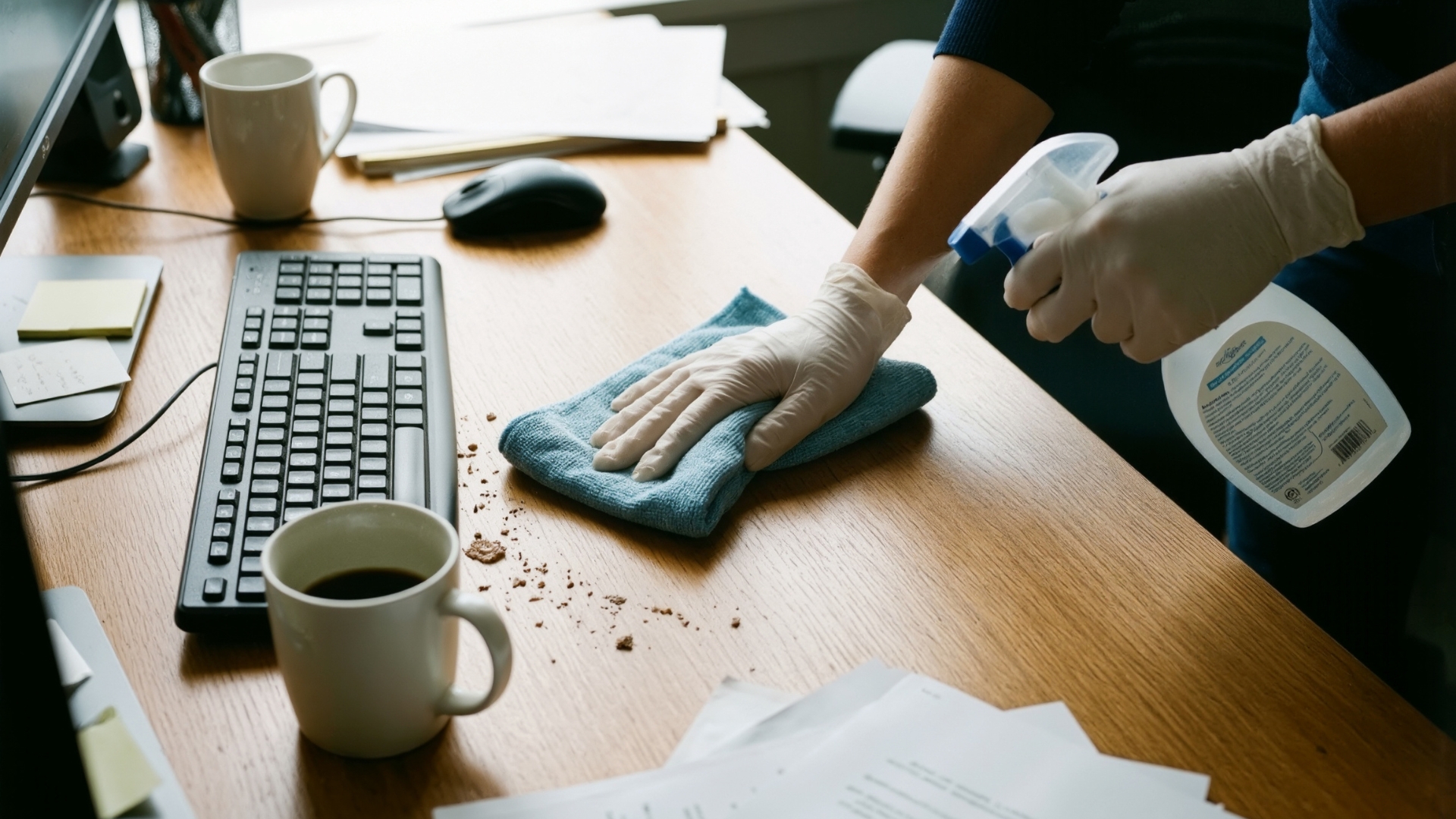
- Desk surfaces
- Keyboards and mice (if permitted)
- Phones and tablets
- Drawer and cabinet handles
- Chair armrests
Proper dwell time compliance:
The critical factor most DIY cleaning misses:
What is dwell time? The length of time disinfectant must remain wet on a surface to kill germs—typically 3-10 minutes depending on product and target pathogen.
Why it matters: Spraying disinfectant and immediately wiping it off (common practice) doesn’t allow sufficient contact time to kill germs. The surface looks clean but remains contaminated.
Professional compliance: Trained cleaners apply disinfectant, allow proper dwell time, then wipe or allow to air dry. This ensures actual germ kill, not just visual cleaning.
Preventing cross-contamination:
Color-coded systems: Professional services use different colored cloths/mops for different areas:
- Red: Bathrooms and toilets
- Yellow: General cleaning
- Blue: Low-risk areas
- Green: Food preparation areas
This prevents transferring bathroom germs to kitchen surfaces, for example.
Microfiber technology: Professional-grade microfiber cloths trap germs rather than spreading them, and are laundered at high temperatures between uses.
Frequent equipment changes: Changing mop heads, cleaning cloths, and solutions regularly prevents spreading germs from earlier-cleaned areas to later ones.
Bathroom sanitization protocols:
Bathrooms require specialized attention:
Proper sequence: Clean from least to most contaminated areas—counters first, toilets last—preventing spread of heavily contaminated material.
Disinfecting all surfaces: Fixtures, stalls, dispensers, walls, floors—comprehensive coverage addressing all potential contamination points.
Floor disinfection: Not just mopping but actual disinfection of bathroom floors where significant contamination exists.
Air quality consideration:
HVAC and vent cleaning: Dust and debris in ventilation systems harbor germs and allergens that circulate throughout offices. Professional cleaning includes vent covers and accessible ductwork.
Air purification: Some professional services offer air purification systems or treatments that reduce airborne pathogens.
Filter maintenance: Ensuring HVAC filters are changed appropriately improves air quality and reduces airborne germ circulation.
Kitchen and break room protocols:
Appliance sanitization: Interior and exterior cleaning of refrigerators, microwaves, coffee makers, and dishwashers addressing bacterial growth areas.
Surface disinfection: Countertops, tables, and eating surfaces properly disinfected—not just wiped.
Sink and drain maintenance: These areas harbor significant bacterial growth requiring specialized attention.
Specialized equipment:
Professional services use commercial-grade equipment achieving results impossible with consumer products:
Electrostatic sprayers: Apply charged disinfectant particles that wrap around and coat surfaces, improving coverage and effectiveness.
UV-C sanitization: Some services offer ultraviolet light sanitization killing germs on surfaces and in air.
HEPA vacuuming: High-efficiency particulate air filters capture microscopic particles including bacteria and viruses that regular vacuums recirculate.
Steam cleaning: High-temperature steam kills germs without chemicals on appropriate surfaces.
Measurable Impacts on Beverly Grove Businesses
Professional germ control delivers quantifiable returns that justify investment.
Reduced sick days:
Studies consistently show professional cleaning with disinfection protocols reduces illness-related absences:
Research findings: Workplaces implementing professional sanitization programs see 20-40% reductions in sick day usage compared to standard cleaning.
Beverly Grove office example: Consider a 25-person Beverly Grove office where employees average 5 sick days annually each:
- Total baseline sick days: 125 days annually
- With professional sanitization (30% reduction): 87.5 days
- Reduction: 37.5 fewer sick days annually
Financial impact:
Direct cost savings: If average employee costs $40/hour ($320/day), 37.5 fewer sick days save $12,000 annually in paid sick time while employees aren’t productive.
Productivity recovery: Beyond paid sick time, recovering those 37.5 work days means completing projects faster, meeting deadlines, and avoiding overtime costs from overloading healthy employees.
Professional cleaning investment: Comprehensive sanitization for this 25-person office costs approximately $600-1,200 monthly ($7,200-14,400 annually)—easily justified by sick day savings alone.
Reduced presenteeism:
Beyond sick days, professional sanitization reduces “presenteeism”—employees at work but functioning poorly due to illness:
Productivity impact: Employees working while sick operate at 50-70% capacity. If professional cleaning prevents 10 employees from working sick for 2 days each (operating at 60% capacity):
- Lost productivity: 8 full days equivalent
- At $320/day value: $2,560 additional recovered productivity
Faster recovery: Healthier workplace environments help sick employees recover faster, returning to full productivity sooner.
Reduced disease spread: When employees do come to work sick (inevitable sometimes), professional sanitization reduces how many colleagues they infect, containing outbreaks that otherwise cascade through entire offices.
Improved morale and satisfaction:
Employee perception: Staff notice when employers invest in their health and wellbeing. Professional sanitization demonstrates company care beyond lip service.
Reduced anxiety: Particularly post-COVID, many employees remain concerned about workplace illness transmission. Visible professional sanitization protocols reduce anxiety and improve workplace comfort.
Retention impact: In competitive Beverly Grove employment market, workplace environment quality influences retention. Health-conscious workplaces attract and keep quality employees.
Client and visitor confidence:
Professional impression: Clients and visitors notice cleanliness and sanitation protocols. Professional cleaning creates confidence in your business standards.
Health concerns: Clients with health vulnerabilities appreciate businesses taking sanitization seriously, influencing their comfort using your services.
Liability reduction:
Outbreak prevention: Serious workplace illness outbreaks can create legal exposure, particularly if negligence in sanitation can be demonstrated. Professional protocols provide documentation of due diligence.
Workers’ compensation: While rare, severe workplace-transmitted illnesses can lead to workers’ comp claims. Prevention through professional sanitization reduces this risk.
Beverly Grove Office-Specific Considerations
Local workplace characteristics create particular sanitization needs and opportunities.
Office density and layout:
Open floor plans: Common in Beverly Grove creative and tech offices, open layouts facilitate germ spread through shared spaces and air circulation. Professional cleaning must address all workstations, not just common areas.
Shared spaces: Collaborative workplaces with hot-desking, shared equipment, and communal areas require more intensive and frequent sanitization than traditional office layouts.
Small footprint offices: Many Beverly Grove offices occupy relatively compact spaces where employees work in close proximity, increasing transmission risk and requiring diligent germ control.
Industry types:
Creative agencies: Collaborative environments with clients visiting frequently require both regular sanitization and ability to schedule deep cleaning around project demands.
Tech startups: Younger workforces working long hours in close quarters need robust germ control preventing productivity-destroying illness outbreaks.
Professional services: Law offices, financial advisors, consultants—client-facing businesses where professional image includes visible cleanliness and implicit health safety.
Medical and wellness: Offices in health-related fields must maintain higher sanitization standards both for patient safety and professional credibility.
Building considerations:
Older buildings: Many Beverly Grove offices occupy charming older structures with HVAC systems and facilities requiring extra sanitization attention.
Shared buildings: Offices sharing buildings with other businesses, restaurants, or retail must maintain germ control despite common areas potentially receiving less attention.
Climate and seasonal factors:
Year-round concerns: Los Angeles’ mild climate means illness isn’t just seasonal—year-round office occupation requires consistent sanitization, not just winter deep cleans.
Santa Ana winds: Periodic windstorms bring increased dust and allergens requiring responsive cleaning.
Air quality days: Poor air quality days mean closed windows and increased indoor air circulation, concentrating germs and increasing sanitization needs.
Workforce demographics:
Commuting patterns: Beverly Grove employees using public transit, ride-shares, or parking structures encounter more germs commuting than those driving personal vehicles. This increases what they bring into offices.
Diverse workforce: Mixed-age workforces include immune-compromised individuals, older employees with higher vulnerability, and parents exposing offices to school-transmitted illnesses.
Implementing Professional Sanitization Programs
Beverly Grove office managers ready to upgrade germ control should understand implementation considerations.
Service frequency options:
Daily cleaning: Ideal for larger offices (15+ employees), high-traffic spaces, or businesses where health concerns are paramount. Provides consistent baseline sanitization.
Multiple times weekly: 3-4 times weekly balances cost with effectiveness for medium-sized offices where daily might be excessive but weekly insufficient.
Weekly cleaning with daily high-touch: Some services offer reduced-scope daily visits (disinfecting high-touch surfaces, bathroom sanitization) plus comprehensive weekly cleaning.
Monthly deep cleaning: Supplementary to more frequent basic cleaning, monthly deep services address areas requiring periodic intensive attention.
Selecting the right service:
Commercial cleaning experience: Office sanitization differs from residential cleaning—ensure services understand commercial environments, can work around business schedules, and have experience with office-specific needs.
Verification questions:
- “What EPA-registered disinfectants do you use?”
- “How do you ensure proper dwell times?”
- “Do you have protocols preventing cross-contamination?”
- “Can you work after hours or during specific windows?”
- “What training do your staff receive on sanitization protocols?”
- “Are you licensed, insured, and bonded?”
- “Can you provide references from other Beverly Grove offices?”
Pricing considerations:
Typical costs for Beverly Grove offices:
Small office (under 2,000 sq ft, 5-10 employees):
- Daily: $400-700/month
- 3x weekly: $300-500/month
- Weekly: $150-300/month
Medium office (2,000-5,000 sq ft, 10-25 employees):
- Daily: $700-1,200/month
- 3x weekly: $500-800/month
- Weekly: $250-450/month
Large office (5,000+ sq ft, 25+ employees):
- Daily: $1,200-2,500+/month
- 3x weekly: $800-1,500/month
- Weekly: $400-800/month
Additional services (deep cleaning, special sanitization treatments, daytime touch-ups) add to base costs.
Scheduling logistics:
After-hours cleaning: Most offices prefer cleaning after business hours preventing disruption and allowing thorough work without navigating around employees.
Early morning options: Some services offer early morning cleaning (5-8am) before employees arrive.
Flexible scheduling: Ability to adjust cleaning times around meetings, events, or special circumstances.
Holiday and weekend availability: Services working around your actual schedule, not just standard Monday-Friday.
Communication and oversight:
Clear expectations: Written agreements specifying exactly what’s included, frequency, timing, and any special protocols.
Quality monitoring: How will you verify quality? Regular inspections? Feedback systems? Service guarantees?
Point of contact: Who do you contact for issues, schedule changes, or special requests? Responsive communication is essential.
Flexibility: Can services accommodate special situations—post-illness deep cleaning, pre-event sanitization, seasonal adjustments?
Beyond Cleaning: Comprehensive Workplace Health
Professional sanitization works best as part of broader workplace health strategies.
Employee education:
Hand hygiene: Encouraging proper handwashing—20+ seconds with soap, particularly after bathroom use, before eating, and after coughing/sneezing.
Respiratory etiquette: Cough and sneeze into elbows, not hands. Dispose of tissues properly.
Stay home when sick: Policies encouraging sick employees to stay home rather than coming to work and spreading illness.
Surface awareness: Educating employees about high-touch surfaces and encouraging personal responsibility (wiping down workstations, not sharing utensils, etc.).
Facility improvements:
Hand sanitizer stations: Placed throughout office—entries, break rooms, conference rooms, by elevators—encouraging frequent use.
Touch-free fixtures: Automatic faucets, soap dispensers, paper towel dispensers, and door openers reduce surface contact transmission.
HVAC upgrades: Better filtration and ventilation reduce airborne pathogen transmission.
Air purification: HEPA air purifiers in common areas and conference rooms capture airborne contaminants.
Policy considerations:
Sick leave policies: Generous sick leave prevents employees coming to work ill because they can’t afford to stay home.
Remote work options: Allowing symptomatic employees to work from home when possible prevents workplace transmission.
Flexible policies: Understanding during illness outbreaks—not penalizing employees for illness-related absences during widespread community outbreaks.
Vaccination encouragement: Supporting flu vaccinations and other preventive measures.
Regular assessment:
Monitoring sick days: Track illness-related absences to identify patterns and assess whether interventions are working.
Employee feedback: Regular surveys about workplace health satisfaction and concerns.
Outbreak response: Plans for responding to workplace illness outbreaks with enhanced cleaning and communication protocols.
Your Beverly Grove Office Health Strategy
Workplace illness isn’t inevitable—it’s preventable through strategic germ control that standard cleaning simply doesn’t provide. For Beverly Grove offices where employee health directly impacts productivity, morale, client relationships, and bottom-line results, professional commercial sanitization represents essential infrastructure, not optional overhead.
The calculation is straightforward: professional services costing $500-1,500 monthly typically save multiples of that investment through reduced sick days, improved productivity, and better employee satisfaction. Beyond financial returns, professional sanitization creates healthier, more pleasant work environments where employees feel valued and protected—increasingly important factors in competitive employment markets.
For Beverly Grove office managers ready to implement professional germ control, commercial cleaning services in Beverly Grove from providers like Cleaning West deliver the expertise, protocols, and accountability that protect your workforce. We understand office environments, use EPA-registered disinfectants correctly, follow systematic sanitization protocols, and work flexibly around business operations.
Your employees deserve healthy workplaces. Your business deserves the productivity that healthy employees deliver. Professional sanitization provides both—transforming offices from germ transmission zones to environments that actively protect health and support success.
The next cold and flu season is coming. Make the strategic investment that keeps your team healthy, productive, and thriving rather than accepting illness as inevitable cost of doing business.